Author: lavonlewis1@gmail.com

Why “Vetted” is Just the Warm-Up: The Case for Owning the Outcome

Every platform has "vetted talent" these days.

LinkedIn screeners. Skills tests. Portfolio reviews. Reference checks. The whole nine yards.

And sure, that matters. You don't want to hand your critical transformation project to someone who can't spell "stakeholder."

But here's the uncomfortable truth most talent platforms won't tell you: vetting gets you to the starting line. It doesn't get you across the finish.

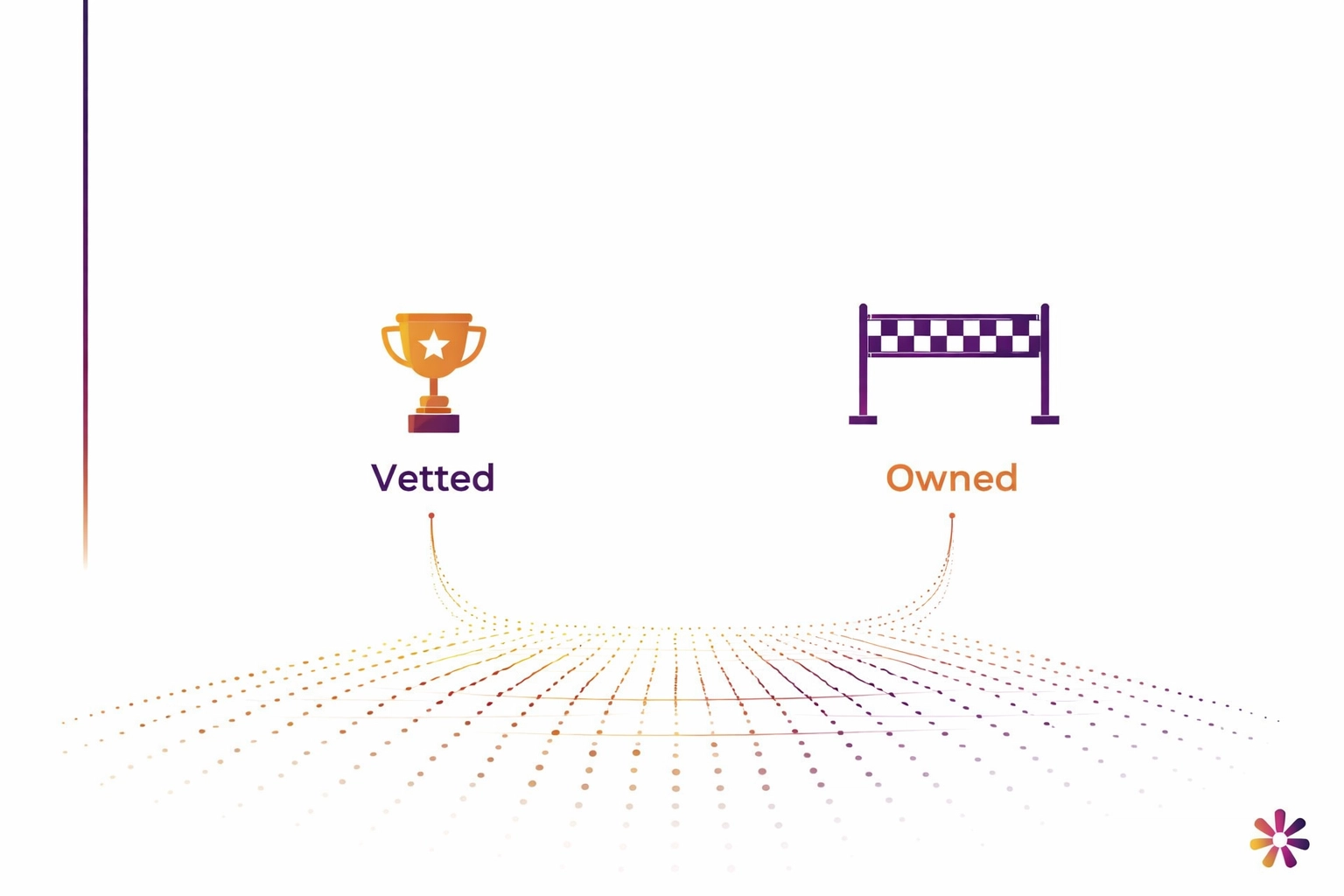
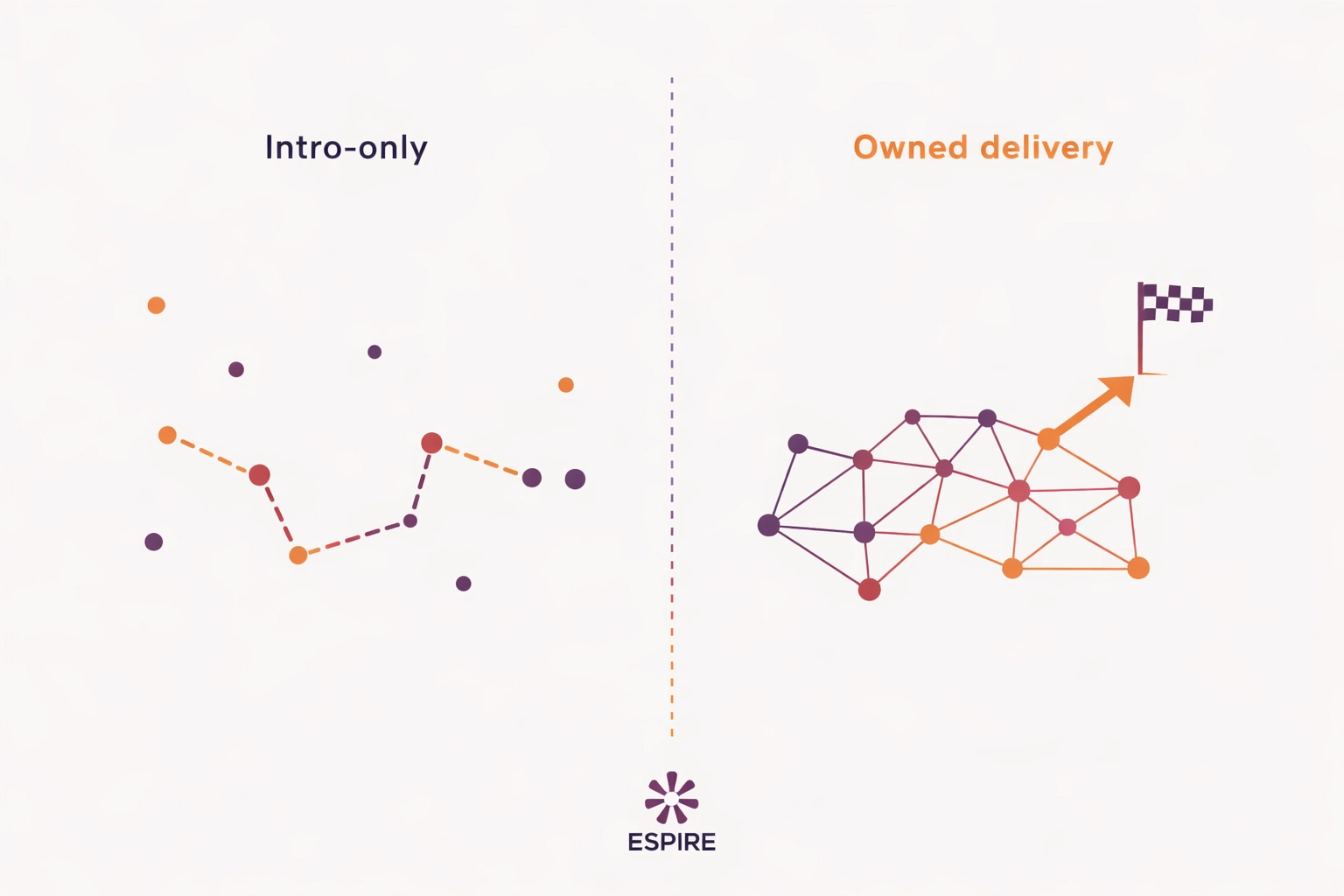
Vetting is the participation trophy. Owning delivery is the finish line.

Because the hardest part of any engagement isn't finding someone smart. It's making sure that person actually delivers what you need, when you need it, under the conditions that exist in your organization, not in a vacuum.

Professional consultant reviewing project delivery challenges at desk

The "Vetted" Illusion: What Actually Breaks Down

Let's talk about what happens after the introduction.

You get matched with a stellar consultant. Great resume. Fantastic interview. Everyone's excited.

Week two: your internal stakeholder can't get time on their calendar.

Week four: the scope has drifted because no one clarified deliverables upfront.

Week six: the consultant ghosts mid-project because a bigger client just called.

Week eight: you're starting over.

The platform that made the introduction? They got paid. They're not responsible for what happens next.

This is the gap between vetted and owned.

Vetted means someone reviewed credentials. Owned means someone is accountable, on an ongoing basis, for execution, governance, and outcomes.

What "Owning the Outcome" Actually Looks Like

Let's get specific. When we say Espire Collective owns delivery, here's what that means in practice:

Single point of contact. You're not managing multiple consultants across multiple contracts with multiple invoices. You work with us. We handle the orchestration.

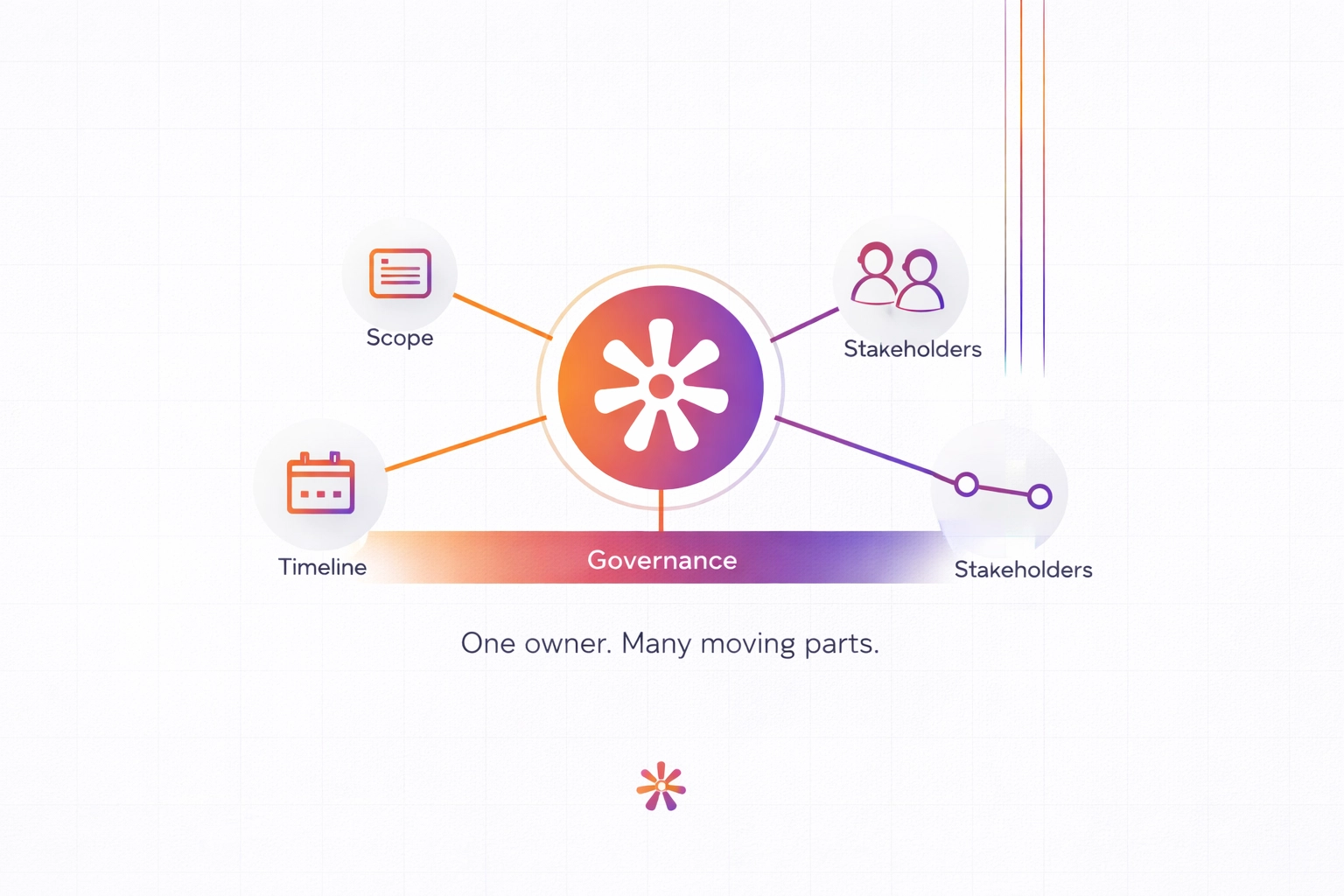
Delivery governance. We don't just introduce you to smart people and disappear. We maintain oversight on scope, timelines, and stakeholder alignment throughout the engagement.

Compliance and risk management. If something goes sideways, regulatory shift, personnel change, deliverable mismatch, we're the ones managing continuity and solving for it.

Strategic flexibility. Your priorities shift mid-engagement? We adjust. You need someone to move from advisory to hands-on execution? Our members operate across that spectrum, and we make it seamless.

This isn't consulting-as-transaction. It's consulting-as-partnership.

Consulting team collaborating on strategic delivery and execution planning

The Hidden Cost of "Introduction-Only" Models

Here's what most companies don't realize until it's too late:

When you hire talent through an introduction-only platform, you inherit all the operational overhead.

You're the project manager. You're the compliance officer. You're the one navigating scope creep, miscommunication, and misaligned expectations.

And when things go wrong? The platform shrugs. "We just make introductions. What happens after that is between you and the consultant."

That model works fine for low-stakes projects. Design a logo. Build a landing page. Write some copy.

But for high-visibility, business-critical work, the kind where failure has real consequences, it's a recipe for expensive chaos.

Strategic transformations don't fail because someone wasn't "vetted" well enough. They fail because no one owned the connective tissue, the alignment conversations, the execution checkpoints, the continuous course-correction that keeps complex work on track.

Why Executive and SME-Level Operators Change the Equation

Here's where Espire Collective's model diverges even further.

There's application for gigs and freelance, but that's not what we do. Espire's members are deeply experienced consultants who operate at the Executive and subject matter expert level, whether they're advising your leadership team or rolling up their sleeves to build the thing.

That range matters.

A lot of consulting engagements fail at the handoff. Strategy gets developed in a vacuum, then handed off to operators who weren't in the room. Or execution happens without strategic context, and the work doesn't ladder up to the real goal.

Our members bridge that gap. They can sit in the boardroom and shape your three-year roadmap. Then they can step into the operation and execute quarter one.

Not as generalists trying to do everything. As specialists who understand how strategy and execution have to talk to each other.

Comparison of unmanaged consulting chaos versus organized delivery governance

Governance Isn't Sexy, But It's Everything

Let's be honest, no one wakes up excited about "delivery governance."

But it's the thing that determines whether your high-stakes project becomes a case study or a cautionary tale.

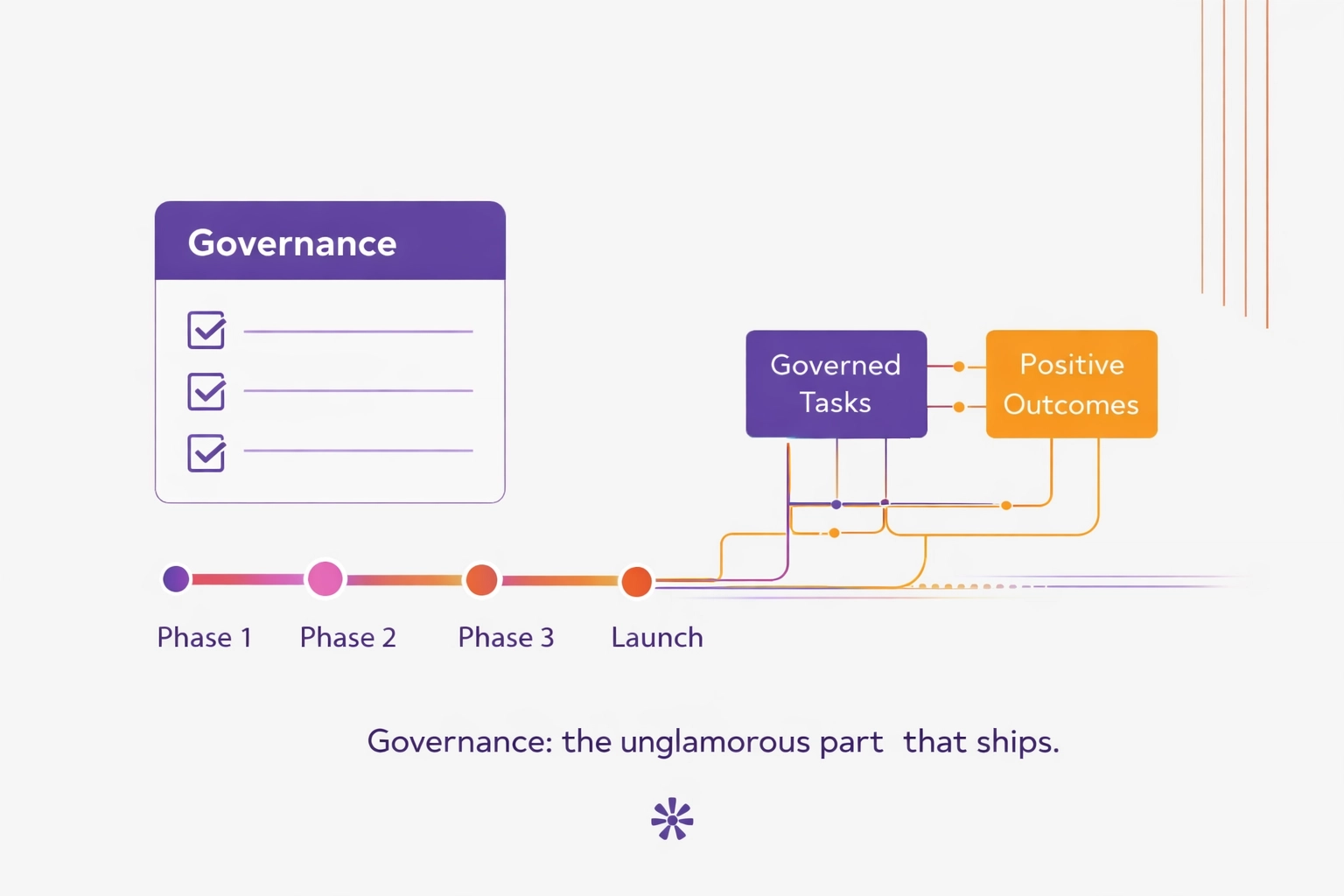
Governance means:

  • Defined success metrics that everyone agrees on upfront, not retroactively.
  • Regular milestone check-ins where we surface risks before they become crises.
  • Clear escalation paths so when decisions need to be made, they get made by the right people.
  • Documentation and continuity protocols so institutional knowledge doesn't walk out the door if someone leaves.

This is the work that happens in the margins. The work that doesn't show up on a LinkedIn profile or a portfolio site.

But it's the difference between "we hired someone great" and "we actually achieved the outcome."

When you work with Espire Collective, we own that layer. You focus on your business. We focus on making sure the engagement delivers.

The Trust Tax (And How We Eliminate It)

Every new consulting relationship starts with a trust deficit.

Can this person do the work? Will they show up? Do they understand our constraints? Will they disappear when things get hard?

In traditional models, you pay that trust tax every single time. New consultant, new risk assessment, new onboarding process, new probationary period while you figure out if they're actually as good as they seemed.

With Espire Collective, the trust layer is built into the model.

We've already done the deep vetting, not just skills, but working style, communication cadence, and ability to operate under real-world constraints.

But more importantly: we're the constant. You're not building trust with a rotating cast of consultants. You're building trust with us, and we ensure consistency, quality, and accountability across every engagement across our community of independent and boutique consultancies.

That eliminates the tax. You're not starting from zero every time.

Hands working on project timeline showing consulting delivery accountability

What This Means for Your Next Engagement

If you're evaluating consulting support right now, here's the lens to apply:

Ask yourself: Who owns the outcome?

Not "who's doing the work": that's table stakes.

Who's accountable if the scope drifts? Who's managing stakeholder alignment? Who's ensuring continuity if priorities shift? Who's responsible for making sure this engagement actually delivers what you need?

If the answer is "you are," you're not hiring a consulting partner. You're hiring labor and managing it yourself.

If the answer is "we are": meaning the organization providing the consultant takes responsibility for delivery governance, execution quality, and continuous alignment: then you've found a model that actually scales.

The Bottom Line: Vetted Gets You In the Door. Owned Gets You to the Finish.

Here's where we land:

Vetting is important. But it's the baseline, not the value proposition.

The real differentiator is who takes ownership: not just of credentials, but of execution, governance, risk, and results.

At Espire Collective, we don't introduce you to great consultants and wish you luck.

We deploy them. We manage the engagement. We own the delivery.

Because at the end of the day, what matters isn't whether someone passed the interview. It's whether they, and we, delivered the outcome you needed.

If you're navigating a high-stakes project and need more than just a warm intro, let's talk. What's been the hardest part of managing external expertise?

Why “Vetted” is Just the Warm-Up: The Case for Owning the Outcome

Every platform has "vetted talent" these days.

LinkedIn screeners. Skills tests. Portfolio reviews. Reference checks. The whole nine yards.

And sure, that matters. You don't want to hand your critical transformation project to someone who can't spell "stakeholder."

But here's the uncomfortable truth most talent platforms won't tell you: vetting gets you to the starting line. It doesn't get you across the finish.

Vetting is the participation trophy. Owning delivery is the finish line.

Because the hardest part of any engagement isn't finding someone smart. It's making sure that person actually delivers what you need, when you need it, under the conditions that exist in your organization, not in a vacuum.

Professional consultant reviewing project delivery challenges at desk

The "Vetted" Illusion: What Actually Breaks Down

Let's talk about what happens after the introduction.

You get matched with a stellar consultant. Great resume. Fantastic interview. Everyone's excited.

Week two: your internal stakeholder can't get time on their calendar.

Week four: the scope has drifted because no one clarified deliverables upfront.

Week six: the consultant ghosts mid-project because a bigger client just called.

Week eight: you're starting over.

The platform that made the introduction? They got paid. They're not responsible for what happens next.

This is the gap between vetted and owned.

Vetted means someone reviewed credentials. Owned means someone is accountable, on an ongoing basis, for execution, governance, and outcomes.

What "Owning the Outcome" Actually Looks Like

Let's get specific. When we say Espire Collective owns delivery, here's what that means in practice:

Single point of contact. You're not managing multiple consultants across multiple contracts with multiple invoices. You work with us. We handle the orchestration.

Delivery governance. We don't just introduce you to smart people and disappear. We maintain oversight on scope, timelines, and stakeholder alignment throughout the engagement.

Compliance and risk management. If something goes sideways, regulatory shift, personnel change, deliverable mismatch, we're the ones managing continuity and solving for it.

Strategic flexibility. Your priorities shift mid-engagement? We adjust. You need someone to move from advisory to hands-on execution? Our members operate across that spectrum, and we make it seamless.

This isn't consulting-as-transaction. It's consulting-as-partnership.

Consulting team collaborating on strategic delivery and execution planning

The Hidden Cost of "Introduction-Only" Models

Here's what most companies don't realize until it's too late:

When you hire talent through an introduction-only platform, you inherit all the operational overhead.

You're the project manager. You're the compliance officer. You're the one navigating scope creep, miscommunication, and misaligned expectations.

And when things go wrong? The platform shrugs. "We just make introductions. What happens after that is between you and the consultant."

That model works fine for low-stakes projects. Design a logo. Build a landing page. Write some copy.

But for high-visibility, business-critical work, the kind where failure has real consequences, it's a recipe for expensive chaos.

Strategic transformations don't fail because someone wasn't "vetted" well enough. They fail because no one owned the connective tissue, the alignment conversations, the execution checkpoints, the continuous course-correction that keeps complex work on track.

Why Executive and SME-Level Operators Change the Equation

Here's where Espire Collective's model diverges even further.

There's application for gigs and freelance, but that's not what we do. Espire's members are deeply experienced consultants who operate at the Executive and subject matter expert level, whether they're advising your leadership team or rolling up their sleeves to build the thing.

That range matters.

A lot of consulting engagements fail at the handoff. Strategy gets developed in a vacuum, then handed off to operators who weren't in the room. Or execution happens without strategic context, and the work doesn't ladder up to the real goal.

Our members bridge that gap. They can sit in the boardroom and shape your three-year roadmap. Then they can step into the operation and execute quarter one.

Not as generalists trying to do everything. As specialists who understand how strategy and execution have to talk to each other.

Comparison of unmanaged consulting chaos versus organized delivery governance

Governance Isn't Sexy, But It's Everything

Let's be honest, no one wakes up excited about "delivery governance."

But it's the thing that determines whether your high-stakes project becomes a case study or a cautionary tale.

Governance means:

  • Defined success metrics that everyone agrees on upfront, not retroactively.
  • Regular milestone check-ins where we surface risks before they become crises.
  • Clear escalation paths so when decisions need to be made, they get made by the right people.
  • Documentation and continuity protocols so institutional knowledge doesn't walk out the door if someone leaves.

This is the work that happens in the margins. The work that doesn't show up on a LinkedIn profile or a portfolio site.

But it's the difference between "we hired someone great" and "we actually achieved the outcome."

When you work with Espire Collective, we own that layer. You focus on your business. We focus on making sure the engagement delivers.

The Trust Tax (And How We Eliminate It)

Every new consulting relationship starts with a trust deficit.

Can this person do the work? Will they show up? Do they understand our constraints? Will they disappear when things get hard?

In traditional models, you pay that trust tax every single time. New consultant, new risk assessment, new onboarding process, new probationary period while you figure out if they're actually as good as they seemed.

With Espire Collective, the trust layer is built into the model.

We've already done the deep vetting, not just skills, but working style, communication cadence, and ability to operate under real-world constraints.

But more importantly: we're the constant. You're not building trust with a rotating cast of consultants. You're building trust with us, and we ensure consistency, quality, and accountability across every engagement across our community of independent and boutique consultancies.

That eliminates the tax. You're not starting from zero every time.

Hands working on project timeline showing consulting delivery accountability

What This Means for Your Next Engagement

If you're evaluating consulting support right now, here's the lens to apply:

Ask yourself: Who owns the outcome?

Not "who's doing the work": that's table stakes.

Who's accountable if the scope drifts? Who's managing stakeholder alignment? Who's ensuring continuity if priorities shift? Who's responsible for making sure this engagement actually delivers what you need?

If the answer is "you are," you're not hiring a consulting partner. You're hiring labor and managing it yourself.

If the answer is "we are": meaning the organization providing the consultant takes responsibility for delivery governance, execution quality, and continuous alignment: then you've found a model that actually scales.

The Bottom Line: Vetted Gets You In the Door. Owned Gets You to the Finish.

Here's where we land:

Vetting is important. But it's the baseline, not the value proposition.

The real differentiator is who takes ownership: not just of credentials, but of execution, governance, risk, and results.

At Espire Collective, we don't introduce you to great consultants and wish you luck.

We deploy them. We manage the engagement. We own the delivery.

Because at the end of the day, what matters isn't whether someone passed the interview. It's whether they, and we, delivered the outcome you needed.

If you're navigating a high-stakes project and need more than just a warm intro, let's talk. What's been the hardest part of managing external expertise?

Why “Vetted” is Just the Warm-Up: The Case for Owning the Outcome

Every platform has "vetted talent" these days.

LinkedIn screeners. Skills tests. Portfolio reviews. Reference checks. The whole nine yards.

And sure, that matters. You don't want to hand your critical transformation project to someone who can't spell "stakeholder."

But here's the uncomfortable truth most talent platforms won't tell you: vetting gets you to the starting line. It doesn't get you across the finish.

Vetting is the participation trophy. Owning delivery is the finish line.

Because the hardest part of any engagement isn't finding someone smart. It's making sure that person actually delivers what you need, when you need it, under the conditions that exist in your organization, not in a vacuum.

Professional consultant reviewing project delivery challenges at desk

The "Vetted" Illusion: What Actually Breaks Down

Let's talk about what happens after the introduction.

You get matched with a stellar consultant. Great resume. Fantastic interview. Everyone's excited.

Week two: your internal stakeholder can't get time on their calendar.

Week four: the scope has drifted because no one clarified deliverables upfront.

Week six: the consultant ghosts mid-project because a bigger client just called.

Week eight: you're starting over.

The platform that made the introduction? They got paid. They're not responsible for what happens next.

This is the gap between vetted and owned.

Vetted means someone reviewed credentials. Owned means someone is accountable, on an ongoing basis, for execution, governance, and outcomes.

What "Owning the Outcome" Actually Looks Like

Let's get specific. When we say Espire Collective owns delivery, here's what that means in practice:

Single point of contact. You're not managing multiple consultants across multiple contracts with multiple invoices. You work with us. We handle the orchestration.

Delivery governance. We don't just introduce you to smart people and disappear. We maintain oversight on scope, timelines, and stakeholder alignment throughout the engagement.

Compliance and risk management. If something goes sideways, regulatory shift, personnel change, deliverable mismatch, we're the ones managing continuity and solving for it.

Strategic flexibility. Your priorities shift mid-engagement? We adjust. You need someone to move from advisory to hands-on execution? Our members operate across that spectrum, and we make it seamless.

This isn't consulting-as-transaction. It's consulting-as-partnership.

Consulting team collaborating on strategic delivery and execution planning

The Hidden Cost of "Introduction-Only" Models

Here's what most companies don't realize until it's too late:

When you hire talent through an introduction-only platform, you inherit all the operational overhead.

You're the project manager. You're the compliance officer. You're the one navigating scope creep, miscommunication, and misaligned expectations.

And when things go wrong? The platform shrugs. "We just make introductions. What happens after that is between you and the consultant."

That model works fine for low-stakes projects. Design a logo. Build a landing page. Write some copy.

But for high-visibility, business-critical work, the kind where failure has real consequences, it's a recipe for expensive chaos.

Strategic transformations don't fail because someone wasn't "vetted" well enough. They fail because no one owned the connective tissue, the alignment conversations, the execution checkpoints, the continuous course-correction that keeps complex work on track.

Why Executive and SME-Level Operators Change the Equation

Here's where Espire Collective's model diverges even further.

There's application for gigs and freelance, but that's not what we do. Espire's members are deeply experienced consultants who operate at the Executive and subject matter expert level, whether they're advising your leadership team or rolling up their sleeves to build the thing.

That range matters.

A lot of consulting engagements fail at the handoff. Strategy gets developed in a vacuum, then handed off to operators who weren't in the room. Or execution happens without strategic context, and the work doesn't ladder up to the real goal.

Our members bridge that gap. They can sit in the boardroom and shape your three-year roadmap. Then they can step into the operation and execute quarter one.

Not as generalists trying to do everything. As specialists who understand how strategy and execution have to talk to each other.

Comparison of unmanaged consulting chaos versus organized delivery governance

Governance Isn't Sexy, But It's Everything

Let's be honest, no one wakes up excited about "delivery governance."

But it's the thing that determines whether your high-stakes project becomes a case study or a cautionary tale.

Governance means:

  • Defined success metrics that everyone agrees on upfront, not retroactively.
  • Regular milestone check-ins where we surface risks before they become crises.
  • Clear escalation paths so when decisions need to be made, they get made by the right people.
  • Documentation and continuity protocols so institutional knowledge doesn't walk out the door if someone leaves.

This is the work that happens in the margins. The work that doesn't show up on a LinkedIn profile or a portfolio site.

But it's the difference between "we hired someone great" and "we actually achieved the outcome."

When you work with Espire Collective, we own that layer. You focus on your business. We focus on making sure the engagement delivers.

The Trust Tax (And How We Eliminate It)

Every new consulting relationship starts with a trust deficit.

Can this person do the work? Will they show up? Do they understand our constraints? Will they disappear when things get hard?

In traditional models, you pay that trust tax every single time. New consultant, new risk assessment, new onboarding process, new probationary period while you figure out if they're actually as good as they seemed.

With Espire Collective, the trust layer is built into the model.

We've already done the deep vetting, not just skills, but working style, communication cadence, and ability to operate under real-world constraints.

But more importantly: we're the constant. You're not building trust with a rotating cast of consultants. You're building trust with us, and we ensure consistency, quality, and accountability across every engagement across our community of independent and boutique consultancies.

That eliminates the tax. You're not starting from zero every time.

Hands working on project timeline showing consulting delivery accountability

What This Means for Your Next Engagement

If you're evaluating consulting support right now, here's the lens to apply:

Ask yourself: Who owns the outcome?

Not "who's doing the work": that's table stakes.

Who's accountable if the scope drifts? Who's managing stakeholder alignment? Who's ensuring continuity if priorities shift? Who's responsible for making sure this engagement actually delivers what you need?

If the answer is "you are," you're not hiring a consulting partner. You're hiring labor and managing it yourself.

If the answer is "we are": meaning the organization providing the consultant takes responsibility for delivery governance, execution quality, and continuous alignment: then you've found a model that actually scales.

The Bottom Line: Vetted Gets You In the Door. Owned Gets You to the Finish.

Here's where we land:

Vetting is important. But it's the baseline, not the value proposition.

The real differentiator is who takes ownership: not just of credentials, but of execution, governance, risk, and results.

At Espire Collective, we don't introduce you to great consultants and wish you luck.

We deploy them. We manage the engagement. We own the delivery.

Because at the end of the day, what matters isn't whether someone passed the interview. It's whether they, and we, delivered the outcome you needed.

If you're navigating a high-stakes project and need more than just a warm intro, let's talk. What's been the hardest part of managing external expertise?

The Power of the ‘Corporate Sister’ Network: Moving from Solo to Systems

Here's what nobody tells you about scaling: the hustle doesn't get you there. The late nights don't get you there. The grit-your-teeth-and-push-through doesn't get you there.

What gets you there? Systems. Infrastructure. And the right people in your corner.

On March 13, 2026, I'll be moderating a panel at the Black Enterprise Women of Power Summit in Las Vegas called SistersInc. Immersion: Finding Support for Your Small Biz. The focus? How to leverage the wealth and influence of both your corporate sisters and major corporations themselves to actually scale: not just survive.

This is the first in a three-part series leading up to that conversation.

And if you're serious about growth, this one's for you, whether you're an organization demanding excellence and professional execution, or an elite independent expert/boutique consultancy ready to scale without the solo hustle.

The Solo Trap: Why "Just Work Harder" Is a Losing Game

Let's get real: most small business owners are operating in survival mode disguised as ambition.

You're wearing all the hats. You're the visionary, the operator, the HR department, the finance team, and the customer service rep. You're also: let's be honest, exhausted.

The narrative we've been sold is that success is a solo sport. That if you just work hard enough, hustle long enough, and stay focused enough, you'll break through.

That's not strategy. That's a participation trophy.

You show up. You try hard. You get a pat on the back. But you don't win the game.

Why? Because growth at scale requires more than effort. It requires capacity: the infrastructure, expertise, and support systems that allow you to handle what comes next without stalling, breaking, or burning out.

Systems First. Then Scale.

Enter the Corporate Sister Network: What It Actually Means

The concept of a "corporate sister network" isn't about feel-good networking events or vague mentorship. It's about strategic, high-trust relationships with people who have resources, influence, and expertise you can leverage to grow.

Think of it like this: sister (or sibling) companies under the same parent share infrastructure, R&D, and talent while maintaining their independence. They don't compete; they collaborate. They pool resources to reduce costs, accelerate innovation, and enter new markets without cannibalizing each other.

Now apply that model to your business.

Your corporate sisters aren't just peers or friends in the industry. They're women (and allies) who have access to capital, contracts, knowledge, and networks that you need. They're executives at Fortune 500 companies, seasoned consultants, corporate lawyers, government contracting pros, and operators who've been where you're trying to go.

And here's the kicker: they want to help. But most small business owners don't know how to ask, how to position themselves, or how to structure the relationship so it's mutually beneficial.

That's where the breakdown happens. Not because the resources don't exist, but because the systems to access them don't exist.

What Good Looks Like: Infrastructure Over Inspiration

Let's talk about what actually moves the needle.

You don't need another motivational quote. You need a delivery engine. A system that ensures when an opportunity shows up, you're ready to execute, not scramble.

Here's what that looks like in practice:

Vetted expertise on demand. You don't need a full-time CFO, but you do need someone who can help you become investment-ready. You don't need a permanent compliance officer, but when a major corporation asks about your governance structure, you better have an answer.

Governance and risk management. Major corporations and investors don't fund chaos. They fund businesses that demonstrate operational maturity, clear accountability, and the ability to scale without falling apart.

Capacity to deliver without stalling. Growth is a test. Can you handle the contract? Can you onboard the team? Can you maintain quality while scaling fast? If the answer is "I'll figure it out," you've already lost.

This is where the Espire Collective model comes in.

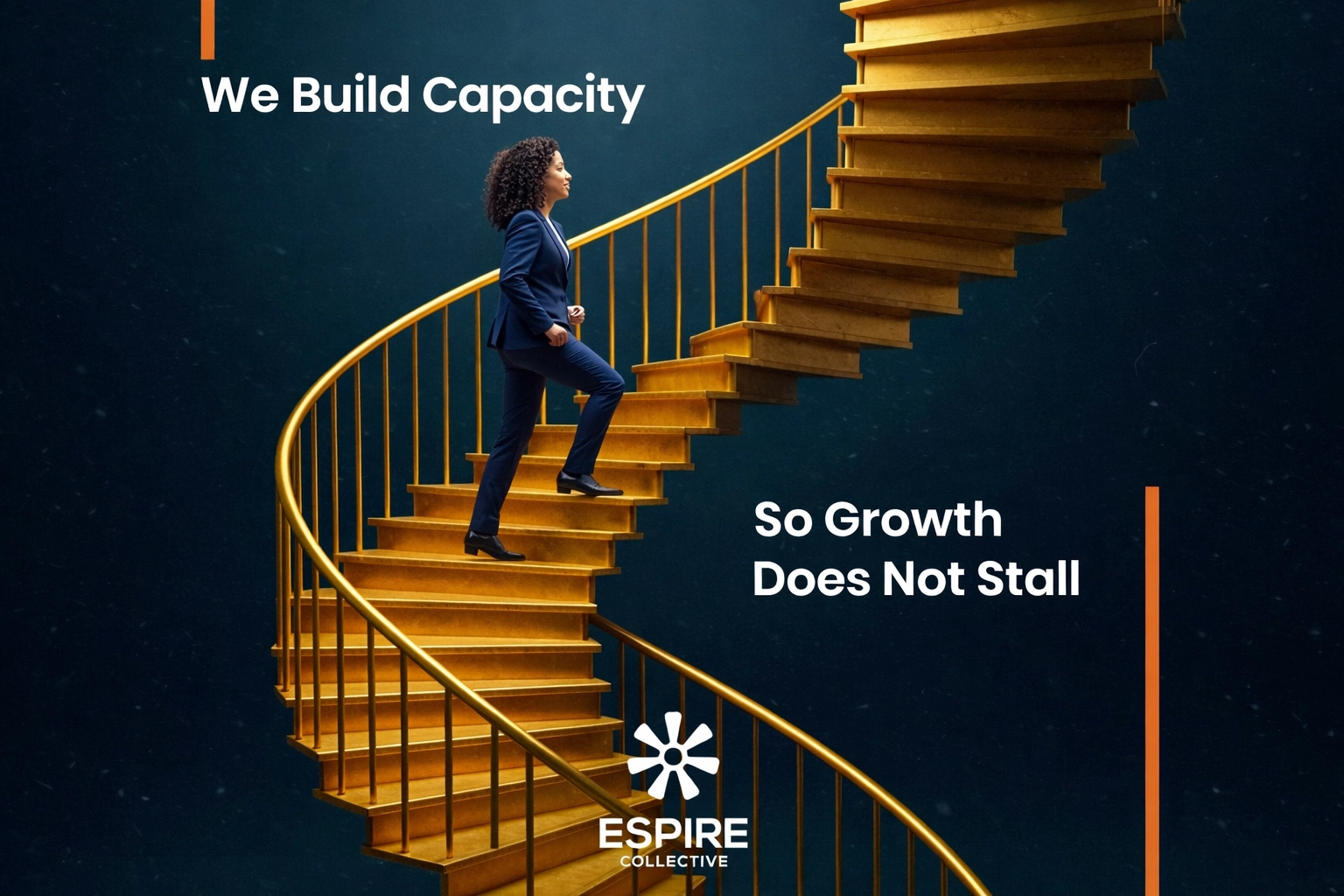
We Build Capacity So Growth Does Not Stall

The Espire Model: A Corporate Sister Network in Action

At Espire, we don't just "introduce" you to talent or "place" freelancers or consultants. We build capacity: a delivery engine with the governance, infrastructure, and senior operators required to execute when the stakes are high for organizations demanding excellence and for elite independent experts/boutique consultancies delivering that excellence.

For our clients: one team, one owner, lower risk

You get a single point of contact. No juggling vendors. No managing a fractured bench. We own coordination end to end so you can stay focused on outcomes.

You get managed delivery. That means scoped work, the right operators in the right roles, and day-to-day execution leadership, so progress doesn't depend on heroics.

You get governance that reduces risk. Clear ownership, documented decisioning, compliance-ready contracting, and continuity if priorities shift. (Translation: fewer surprises, less exposure, and delivery you can stand behind).

For experts/boutique owners: scale without the solo hustle

You get shared deal flow. Not random one-off gigs. Aligned opportunities where your expertise can actually land and compound.

You get operations infrastructure. Business development, scoping support, delivery frameworks, and the operational rails that let you spend more time doing the work, and less time chasing, invoicing, and reinventing the wheel.

You get a collaborative ecosystem. Work alongside other trusted operators, form delivery teams, and build relationships that outlast a single project, like corporate sisters do when they share capabilities instead of competing for scraps.

You get free and exclusively discounted vetted business resources. Save time and money by accessing vetted product and service partners who provide curated offers you need to do business. Think about every time you had to acquire new insurance, back-office support, a financial partner, or secure a time-saving application. These are the silent killer activities you do not hear much about, but you feel the impact every day.

This is what a modern corporate sister network looks like: a collective of high-trust experts who operate like an ecosystem, not a marketplace. Whether you're hiring or delivering, you tap in when you need capability, and you move from solo effort to system-level execution.

The Participation Trophy vs. the Outcome

Let's use a metaphor that lands.

A participation trophy means you showed up. You tried. You get credit for effort.

An outcome means you executed. You delivered. You created measurable impact.

In the world of small business growth, most resources fall into the participation trophy category:

  • Generic business courses that teach theory, not application.
  • Networking events where you collect business cards but no contracts.
  • Mentorship that's inspirational but not operational.
  • Funding pitches that go nowhere because you don't have the infrastructure to execute.

None of that scales your business. It just makes you feel busy.

Outcomes look different:

  • You secure a corporate contract because you had the compliance infrastructure in place.
  • You close a funding round because your financials were audit-ready.
  • You scale without breaking because you had senior operators helping you build the systems before the growth hit.

That's what leveraging a corporate sister network: whether it's Espire or the executives you'll meet at Women of Power: actually delivers. Not inspiration. Execution.

Finding Support: It's About Shared Wealth and Influence

Here's the truth about funding and scaling that nobody wants to say out loud: although for many access is a part of the problem. Readiness is often the bigger barrier.

There are corporate partnerships available. There are funding sources. There are major corporations actively looking to work with diverse suppliers and small businesses.

But if you don't have the infrastructure to deliver, you won't get the contract. If you can't demonstrate operational maturity, you won't get the capital.

This is why the corporate sister network matters. It's not just about finding resources: it's about leveraging the collective wealth and influence of people who can help you get ready.

Your corporate sister at a Fortune 500 company? She can tell you what procurement actually looks for. She can introduce you to the right buyers. She can help you position your business so you're not just in the room: you're competitive.

Your corporate sister who's a consultant? She can help you build the governance framework you need. She can operationalize your strategy so it's not just a deck: it's executable.

That's shared wealth. That's shared influence. And that's how you move from solo to systems.

Growth Requires More Than Opportunity

What's Next: Join the Conversation in Vegas

This is the first piece in a series leading up to SistersInc. Immersion: Finding Support for Your Small Biz at the Black Enterprise Women of Power Summit, March 11–15, 2026, at the Bellagio in Las Vegas.

The session on March 13th will dig into the practical, tactical realities of understanding your options, leveraging both corporate partnerships and your network to access capital and scale. No fluff. No participation trophies. Just outcomes.

If you're serious about growth, this is where the conversation starts.

And if you're already thinking about how to build the infrastructure to handle that growth? Espire Collective is designed exactly for that. From advisory to execution, we build capacity so growth doesn't stall.

Stay tuned for the next post in this series: "Funding the Outcome: Why Strategic Governance is Your Best Capital Magnet."

In the meantime, I'm curious: what's the biggest gap between where you are and where you're trying to scale? Drop a comment or shoot me a message (I'm collecting real stories for the panel). I look forward to seeing you at the Summit. See you there!

The Hidden Cost of Traditional Hiring Is Time. And Time Is Bleeding Companies Dry.

Every delayed hire has a cost no spreadsheet shows.

Missed opportunities. Burned-out teams. Projects that stall while leaders wait for “the right person.”

Meanwhile the market keeps moving.

Espire helps organizations bypass the bottleneck. Instead of one hire, you access a bench of experience. Instead of months, you move in weeks. Instead of risk, you gain traction.

This is how modern companies scale responsibly. Flexible teams. Proven talent. Clear outcomes.

Hire Talent: https://calendly.com/d/ctgg-r6x-r2g/business-discovery-call

Why Top Consultants Are Leaving Firms and Joining Collectives

The old consulting model is cracking.

Brilliant operators are tired of being boxed in by titles, billable hours, and layers of approval that slow real impact.

They want freedom and scale at the same time. In a collective, something powerful happens. Experts stay independent. Clients get Executive and senior-level thinking. Results move faster because ego and red tape are gone.

Espire was built for consultants who already know their value. People who want meaningful work, strong alignment, and access to greater capacity for revenue-generating opportunities, without giving up their autonomy.

No politics. No fluff. Just work that matters.

Hire Talent: https://calendly.com/d/ctgg-r6x-r2g/business-discovery-call 

The Fastest Growing Companies Are Not Hiring. They Are Assembling.

There is a quiet shift happening.

The companies moving fastest right now are not posting jobs, waiting months, or rebuilding teams from scratch.

They are assembling expertise on demand.

Picture this. A leadership table where every seat is filled by someone who has done this before. Strategy. Execution. Growth. No ramp-up. No guessing.

That is the power of a collective model done right.

Espire exists for organizations that cannot afford delay. You plug in the expertise you need. You scale without adding weight. You move with confidence instead of caution.

This is not a gig marketplace.

This is not task-based outsourcing.

Espire connects organizations with seasoned talent who lead, execute, and move outcomes forward with intention.

That is precision.

Hire Talent: https://calendly.com/d/ctgg-r6x-r2g/business-discovery-call

What We’re Building at Espire Will Change How Teams Scale in 2026

We have exciting news.

The Espire Collective is here, and what we are building going into 2026 opens powerful new opportunities for the people connected to our ecosystem.

What Espire Is Building

Espire is a collective of proven consultants who come together to help organizations move faster, operate smarter, and scale with confidence. Our model gives companies immediate access to trusted independent talent for leadership, strategy, and execution without traditional recruiting delays or overhead.

What makes this different is flexibility and momentum. Companies can engage one expert or an entire team, stay fully compliant, and move forward without the friction that usually slows growth. That is exactly why demand is accelerating.

What’s Opening Up in 2026

We are already laying the groundwork for expanded partnerships, new projects, and larger engagements heading into 2026. 

If you would like a quick overview of what’s ahead and how this could connect to your goals, feel free to schedule a short intro call. More announcements and opportunities are right around the corner.

Looking forward to sharing what’s next!

Hire Talent: https://calendly.com/d/ctgg-r6x-r2g/business-discovery-call

Unveiled: GovCon Stories Podcast

Real Conversations. Real Lessons. Real GovCon.

Hosted by Tasha Jones, CEO of The Espire Collective, and Yas Wynn, Unveiled: GovCon Stories takes you behind the scenes of government contracting through the voices of the small businesses driving real impact.

Each episode pulls back the curtain on what it truly takes to compete, collaborate, and grow in the U.S. public sector — from navigating procurement hurdles to scaling for federal opportunities.

Tasha and Yas bring candid conversations, expert insights, and firsthand experience to uncover the wins, lessons, and untold stories shaping the GovCon community.

Whether you’re new to government contracting or ready to deepen your influence in the space, Unveiled offers the clarity, strategy, and inspiration to help you thrive.

Listen Now

Return to the Resources Page

The Rise of the Collective: Why the Future of Work Belongs to Builders, Not Firms

The future of work isn’t corporate. It isn’t contract-based.
It’s collective.

Across industries, a quiet revolution is taking shape. Mid-market companies are scaling lean. Public-sector organizations are demanding agility without red tape. And seasoned professionals are stepping out of traditional firms to build something more intentional, something that values independence and interdependence.

This is where Espire Collective comes in. We’re redefining what a talent marketplace can be: not just a platform for finding people, but an ecosystem where top talent and ambitious teams grow together.

Built for the Middle, Where Real Work Happens

For too long, the world of work has been split in two:
On one end, transactional platforms that treat experts like profiles.
On the other, oversized consulting firms with rigid processes and inflated retainers.

Between them is the missing middle, a generation of experts, specialists, and agile teams who thrive on impact and collaboration. They don’t need hierarchy; they need infrastructure. They don’t want busywork; they want purpose-driven projects that match their craft.

Espire was built for them.
A modern consulting collective that brings together those who build, solve, and deliver — without the layers of bureaucracy that slow innovation down.

We exist for:

  • Experienced professionals who want meaningful, high-value work
  • Small teams who execute with precision
  • Clients who need flexible, compliance-ready solutions that deliver results

When those worlds meet, the work becomes transformational.

The Power of Collective Growth

At Espire, we believe every partnership should create shared value. Our model blends strategy, systems, and the African philosophy of Ubuntu — “I am because we are.”

That’s more than a mantra. It’s how we operate:

  • Clients become collaborators, not transactions
  • Consultants become partners, not placeholders
  • Every win becomes a shared victory

For our members, that means deal flow, back-office support, and community that fuels real growth.
For our clients, it means vetted experts, faster delivery, and seamless compliance across both private and public sectors.

Espire isn’t a directory. It’s a movement, one designed for people who are building something that matters.

Where Builders Belong

The world doesn’t need more platforms. It needs ecosystems, curated, collaborative, and built on trust.

That’s what Espire Collective is creating: a new model of partnership where expertise meets execution, and every project strengthens the network.

Whether you’re a seasoned consultant ready to grow or a business ready to scale, this is where you belong.
The future of work isn’t solo or siloed. It’s collective.

Join as Talent

Hire Talent

Return to the Resources Page